
Blog
Can your intestine micro organism predict your age and life-style? Unusual examine says sure

Nov
In a examine not too long ago printed within the journal Communication biologyResearchers examined environmental elements related to coabundance within the human intestine Microbiome.
Complexity of the intestine microbiome ecosystem
A rising physique of analysis has described options related to intestine microbiome composition in well being and illness. Salient traits embody gender, age, host genetics and food plan. Nonetheless, some features of the host-microbiome relationship are tough to characterize. The intestine microbiome is a advanced ecosystem, and its elements type subcommunities by way of interactions between taxa.
Co-abundance and purposeful connectivity
The subcommunities exhibit co-occurrence as a result of they work collectively as a coherent purposeful group or consume the identical sources from the native setting. Exploring taxa co-occurrence and connectivity inside the microbiome can benefit determine options that might in any other case be missed by univariate approaches. Nonetheless, there isn’t a gold normal technique for screening elements related to adjustments in bacterial coabundance between people inside a inhabitants.
MANOCCA technique for coabundance evaluation
In the current examine, researchers characterised relationships between environmental elements and adjustments within the coabundance community of the intestine microbiome. First, multivariate evaluation of conditional evaluation of covariance (MANOCCA) was used to look at the associations between 80 environmental elements (host traits) and the coabundance of taxa on the household, genus, and species ranges utilizing knowledge from 938 wholesome contributors.
Associations between host traits and co-frequency
This recent technique eradicated key limitations of earlier approaches by supporting each steady and categorical predictors, permitting for covariate adjustment, and offering a proper statistical framework for individual-level cofrequency.
MANOCCA is a covariance-based method that permits formal statistical testing of associations between the covariance of taxa and arbitrary predictors and was developed to deal with present limitations.
Knowledge on host traits had been collected at baseline and included demographics, medical historical past, dietary habits and biomarkers. MANOCCA confirmed important associations with gender, age and smoking in any respect three taxonomic ranges and physique mass index (BMI) on the genus degree.
Community construction and interactions between genera
Notably, taxa coabundance associations had been enriched for dietary traits, indicating a modest however systematic affect of food plan on the taxa interplay community.
Subsequent, the group carried out contribution weights for gender, age, BMIand smoke alerts, discovering that the majority taxa had nonzero and basically heterogeneous contributions to the affiliation.
MANOCCA weights had been in comparison with univariate imply impact p-value associations derived from normal linear regression. There was a major constructive correlation between the 2 outcomes for smoking, BMIAge and intercourse, indicating a twin affect on the abundance and abundance of many genera.
A core of roughly 200 genera was systematically influenced by all four elements, suggesting a central position within the community construction. Subsequent, the group analyzed the traits of the highest 5% of genera pairs that contribute most to family-level variability in coabundance. Amongst 151 households, 10, 8, 11, and 7 overlapping teams of households coated ≥50% of genera with the best contribution for age, intercourse, smoking, and many others BMIrespectively.
Essentially the most primary households included Lachnospiraceae, Bacteroidaceae, Ruminococcaceae, AcutelibacteraceaeAnd Oscillospiraceaewith uncommon households like Eggerthellaceae, Peptostreptococcus householdAnd Among the many Baculaceae. Above all, Bacteroidaceae had been underrepresented in coabundance adjustments, whereas Oscillospiraceae had been closely influenced, particularly in relation to BMI.
The evaluation additionally recognized four co-abundance teams (CAG-74, CAG-508, CAG-272 and CAG-138) that contributed to the sign.
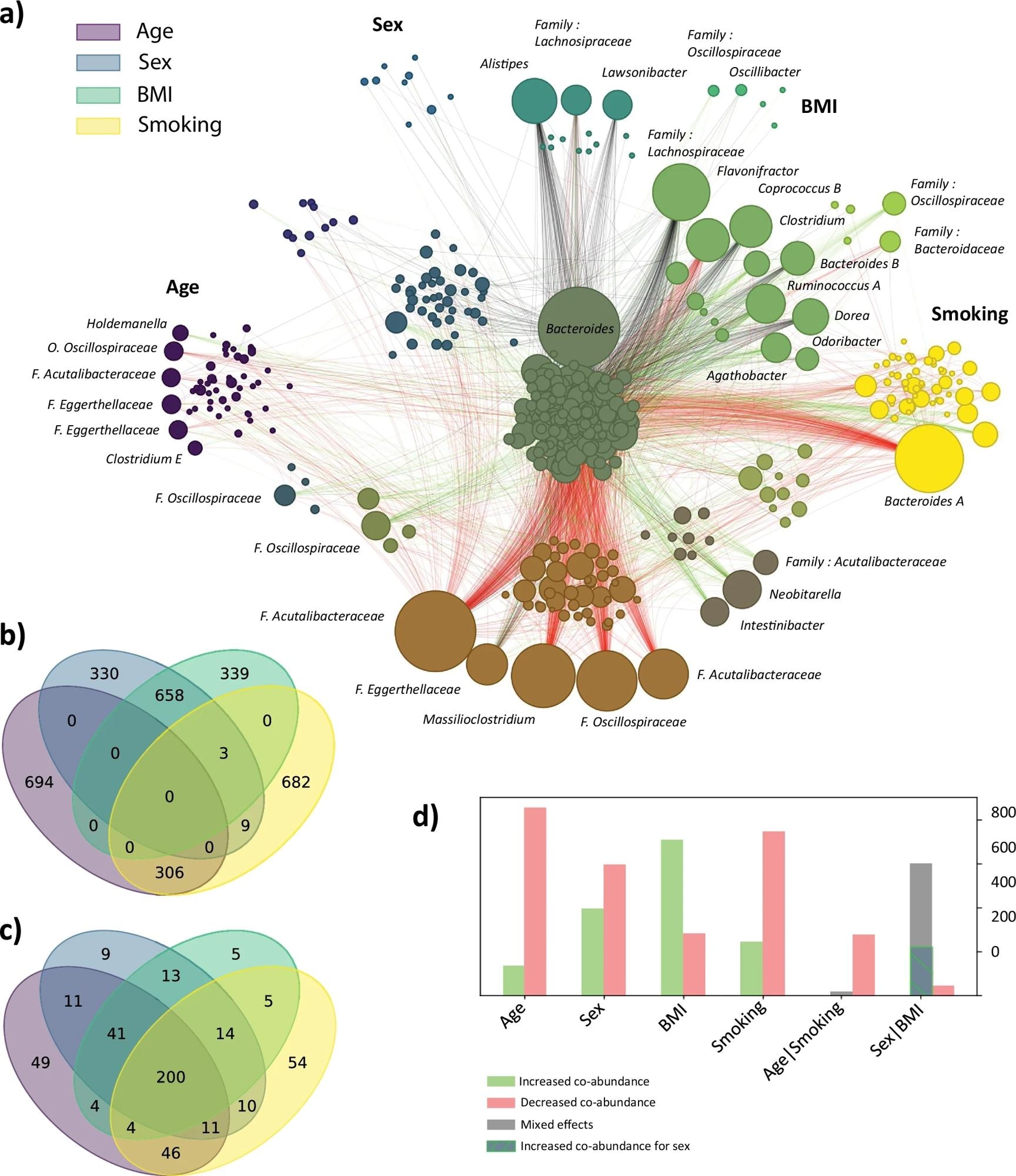
Predictive efficiency and conclusions of the examine
Subsequent, the group created a community of coabundance variations from the highest 1,000 genera pairs that contribute to the MANOCCA affiliation sign. In complete, 4,000 pairs comprised 476 distinctive genera.
Notably, the researchers noticed important overlap in pairs of co-occurring taxa influenced by each BMI and gender (658 joint pairs) as nicely as by smoking and age (306 joint pairs). Elevated smoking and growing age had been primarily related to a lower in coabundances, whereas they had been greater BMI was related to an improve.
Intercourse confirmed a combined sample. For instance, Bacteroides A confirmed decreased coabundances with many core taxa in people who smoke, though there was no affiliation in relative abundance, illustrating how covariance evaluation can detect interplay shifts missed by conventional abundance-based strategies. Lastly, the group evaluated the accuracy of MANOCCA in predicting essentially the most generally related options (BMIsmoking, age and intercourse) utilizing household, genus and species degree taxa.
Accuracy was firm utilizing the world below the receiver working attribute curve and squared correlation (r²) for binary and steady outcomes, respectively. The covariance-based prediction mannequin was in contrast with a typical linear mannequin based mostly on relative abundance. The group discovered that MANOCCA outperformed the normal mannequin and was considerably extra correct.
Prediction achieve was important for age, with imply r²(age) values of 0.18 (household), 0.25 (genus), and 0.27 (species) for MANOCCA fashions, representing a 3-fold enchancment over abundance-based fashions.
The corresponding r²(age) estimates from the normal mannequin had been 0.05, 0.07, and 0.10, respectively. For MANOCCA, the prediction for intercourse was considerably greater in any respect taxonomic ranges.
Broader implications and future functions
In conclusion, the examine examined the associations between host traits and the co-occurrence of the intestine microbiome in wholesome people. MANOCCA confirmed important associations between taxa coabundance variability and age, intercourse, BMIand smoking.
The community of genera with the best contributions confirmed that interplay variability was restricted to a small variety of households. Coabundance variability was concentrated in a restricted variety of households, with interfamily interactions far outweighing intrafamily connections. Moreover, interactions had been primarily noticed between genera of totally different households relatively than inside the identical household.
The MANOCCA framework can be used to develop predictive fashions. The predictive energy of taxa coabundance-based fashions was considerably greater than that of a typical abundance-based mannequin for all traits. Nonetheless, the authors famous that the MANOCCA technique requires massive pattern sizes (usually over 100 contributors) and doesn’t explicitly mannequin the composition of the microbiome knowledge, which must be refined in future work.
Journal reference:
- Boetto C, Romero VB, Henches L, et al. (2025). The affect of the setting on the bacterial prevalence within the intestinal microbiome of wholesome folks. Communication biology8(1), 1537. DOI: 10.1038/s42003-025-08895-y, https://www.nature.com/articles/s42003-025-08895-y
